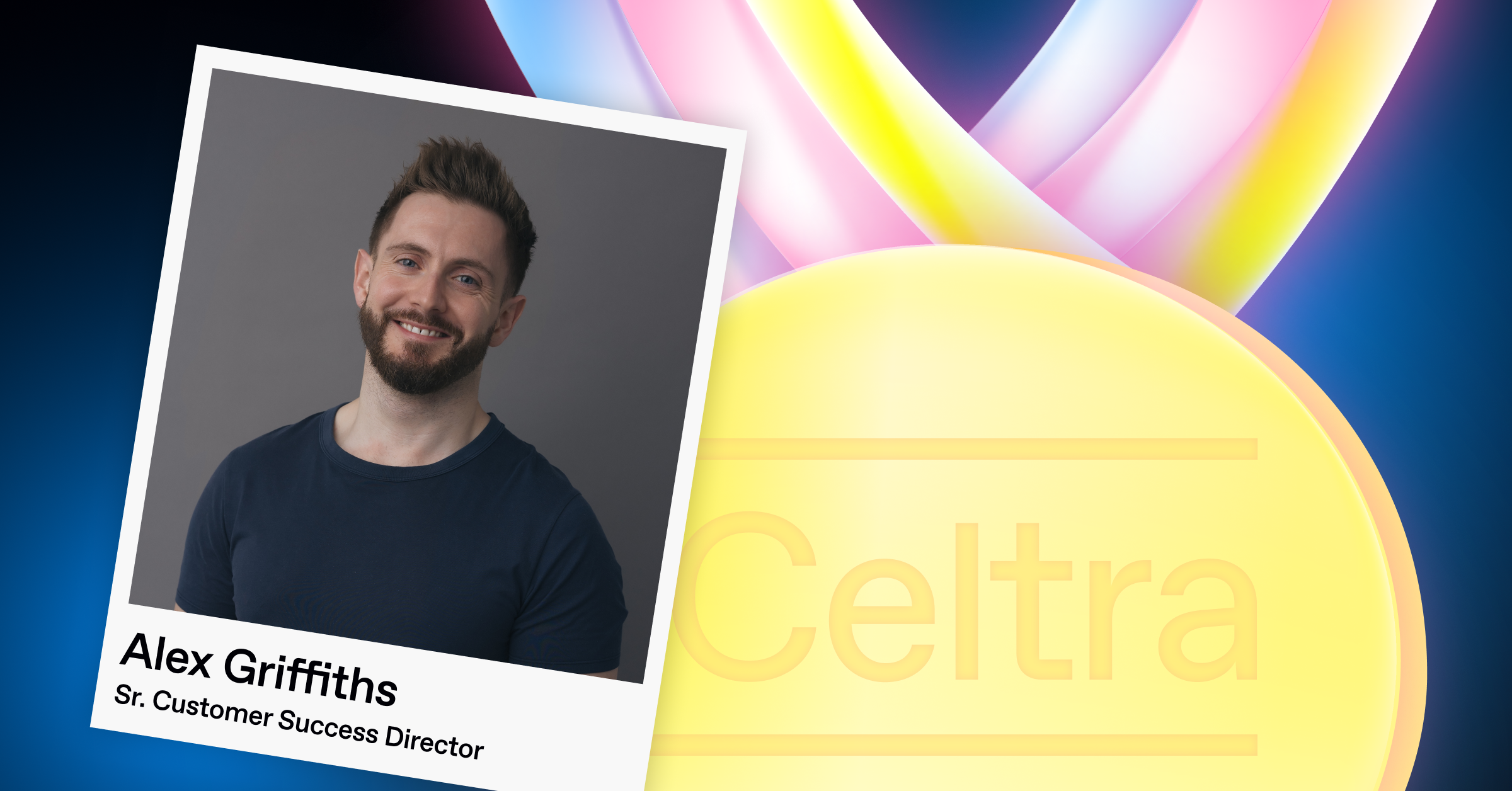
Customer success is often misunderstood, and Alex Griffiths has seen that firsthand. He started his career in agency account management before moving into SaaS, where he found a role that combines relationship building, data analysis, and commercial focus, far beyond simply solving problems as they arise. Today, as a Senior Customer Success Director at Celtra, he defines success through clear goals, structured processes, and close collaboration across teams, giving a practical view of what the role really involves.
What sparked your interest in customer success, and how did your career path unfold from there?
I began my career at a design agency in Soho, before moving into account management at an integrated agency. Those early roles were intensely client-facing and quickly taught me two things: how to build trust with people, and how to keep a commercial view on client work. That mix of relationship skills and a business-first mindset made customer success a natural next step for me.
To me, customer success is the SaaS equivalent of a seasoned account manager or account director, with the added responsibility of shaping product and operational outcomes across a large book of businesses. I enjoy growing accounts both commercially and relationally, defining clear success criteria, delivering practical insights clients can act on, and acting as a trusted adviser to help customers achieve measurable results.

What are the top 2–3 traits that make a great customer success professional, and why?
1. Technical and analytical curiosity
Being comfortable with data and the technology behind the product lets you spot issues early, diagnose problems independently, and have credible strategic conversations with clients and product teams. That fluency drives stronger, faster decision-making.
2. Personable relationship skills
Customer success is about partnership. You need to build and maintain trust so clients share goals, constraints and candid feedback. That sometimes means being highly available (especially during campaign launches or other critical moments) — but in return, you get access to higher-value conversations and insights you wouldn’t see otherwise.
3. Commercial and operational discipline
Great customer success managers prioritise where to spend time for the best return. They communicate clearly (onboarding, account reviews, escalations, joint business planning) and design repeatable processes. Knowing where to invest in, and how to operationalise that work, lets teams scale without sacrificing quality.

What does a ‘typical’ day look like as a customer success director at Celtra?
There’s no truly “typical” day, but my time usually falls into two buckets: client-facing work and inward-facing coordination. About 70% of my time is client-facing: calls to assess progress and next steps; executive and monthly business reviews, prep and delivery; tactical training; and ad-hoc troubleshooting. I also run regular analyses for clients (monthly business reviews, tactical deep dives, or executive business reviews) to surface risks and opportunities.
The remainder of my time is inward-facing: monitoring customer health and progress against agreed goals; supporting CSMs as a sounding board and helping resolve issues I’ve seen before; coordinating with product, sales and engineering on escalations and priorities; and producing the analyses and materials that feed strategic customer conversations. I deliberately block time for deeper strategic work, such as account planning and longer-term initiatives, so those efforts don’t interrupt client-facing time.
What are the biggest challenges you face in your role, and how do you tackle them?
1. Measuring value and impact
Clients don’t always come with clear KPIs, so proving we’ve made a difference can be tricky. I fix that by working with customers up front to agree on measurable objectives and then linking those to commercial outcomes in regular reviews. We focus on a few simple signals like adoption, time-to-value, and usage patterns, and run short pilots to see what actually moves the needle.
2. Managing competing goals
Product, sales, and engineering often have different priorities that can affect client outcomes. I handle that with regular alignment meetings where frontline customer data and knowledge lead the discussion, and by circulating clear follow-ups with named owners so actions actually happen and stay focused on client impact.
3. Keeping quality consistent as we scale
As our customer base and product complexity grow, it’s hard to keep service consistent. We avoid reinventing the wheel by standardising common processes, automating routine tasks (I’m big on this), and documenting quick fixes for frequent issues. We’re also piloting AI and other automation to lift the admin burden so CSMs can spend more time on strategic, high-value work.
How has your role evolved since you joined Celtra? Any big pivots or surprises along the way?
When I first joined, I was mostly in reactive mode; onboarding customers, putting out fires, and fixing whatever came up. Over time, we built the basic processes and templates that stopped repeat issues, which let me move into more proactive work: helping customers get more from the product, spotting growth opportunities, and leading conversations about expansion.
The biggest surprise has been how closely people actually work together here. CS, product, sales, and engineering talk to each other regularly, so when we find something customers need, we can iterate and ship fixes quickly.
What do you love most about your job, and what makes Celtra stand out as a place to work?
I enjoy the mix of people and problem-solving: meeting customers, understanding what’s holding them back, and finding practical fixes to improve their campaigns. It’s genuinely rewarding to see small changes we suggest turn into measurable improvements.
For me, Celtra stands out because the product is solid, and people actually help each other. Celtronians are a collaborative bunch who take ownership, and we’re a sociable team — that combination makes the work demanding yet enjoyable.

What’s the one tool or habit that keeps you sane and productive?
…Honestly, I go to the gym after work — it’s a hard stop that helps me clear my head and reset. At work, I lean on AI for the more menial stuff: ChatGPT and Gemini help me automate admin tasks and support routine analysis, giving me a quick steer on reports so I can focus on the ‘why’ it matters for a client.
What’s something about your role that most people misunderstand?
People often think customer success is just firefighting and being a friendly account manager. It’s not. A lot of what we do is strategic — figuring out the right KPIs, using data to prove what’s working, influencing product decisions, and helping customers grow. So yes, it’s relationship work, but it’s also technical and commercial.

Liked this article? Read the previous Career Paths Q&A, or check out our content hub for more culture and industry-related blogs. Interested in a career at Celtra? Check available positions and apply today!