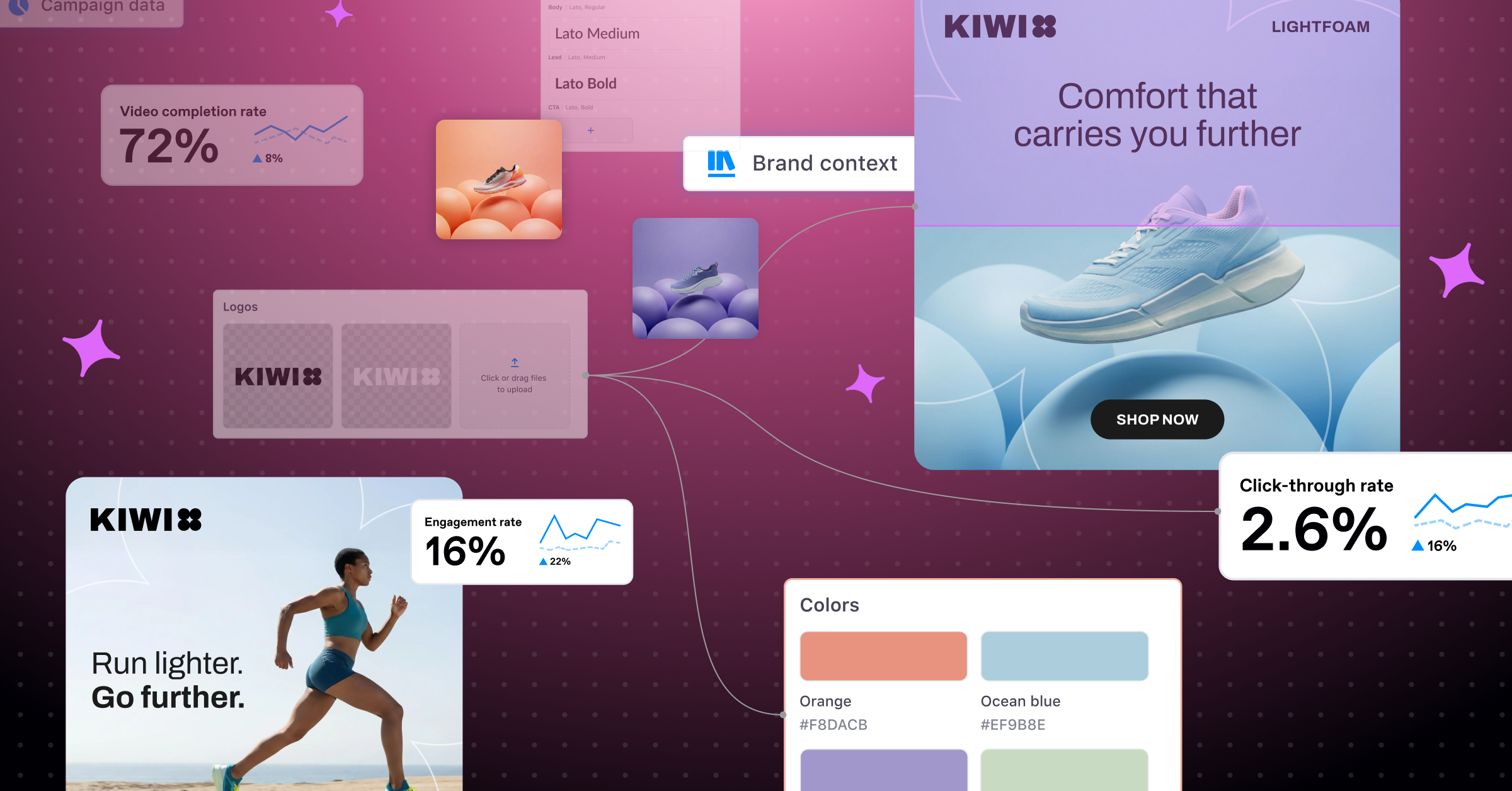
Agentic advertising has quickly become one of the defining conversations shaping the future of marketing. As AI evolves from generating individual assets to operating as autonomous creative systems, the industry is moving from experimentation to real-world application.
But as adoption accelerates, so do the questions. Not about whether AI can scale creative (we know it can), but whether it can do so in a way that is controlled, consistent, and truly on-brand.
Pia Malovrh, Director of Product at Celtra, has been closely involved in these conversations as part of the AgenticAdvertising.org (AAO), where Celtra is one of the founding members, working alongside brands, agencies, publishers, and technology partners to help define the standards and infrastructure that will shape the next decade of advertising.
In the following perspective, Pia explores a critical gap in today’s agentic advertising landscape and shows how Celtra, together with industry partners, is working to close it through new standards like brand.json.
The shift to agentic advertising is a shift in roles
I’ve spent a lot of time recently in the rooms where the future of advertising is being shaped, and I use “rooms” loosely. Some are conference calls. Most are Zoom calls. A few are Slack threads that are turning into industry policy.
Celtra is a founding member of the AAO, and being part of that work, helping define the standards and infrastructure that the industry will build on for the next decade, is something I’m genuinely proud of. Not because of the seat at the table, but because of the people in the room: brands, agencies, publishers, technology partners, all trying to figure out, together, how to move this industry forward responsibly. That collaborative energy, the shared commitment to getting this right rather than just getting there fast, is what makes me genuinely optimistic about where we’re headed.
The most important shift happening in advertising right now isn’t about AI generating more creative. It’s about what happens to the people who used to do it.
- Designers who spent their careers making assets are becoming system operators.
- Brand leads are becoming governance architects.
- Creative directors are becoming curators of logic, not just aesthetics.
The human stack is changing, and the teams that embrace that change earliest will define what great agentic creative actually looks like.
But here’s what I keep coming back to: that shift only works if the infrastructure supports it. And right now, it doesn’t.
The problem with agentic advertising is not AI capability
When a creative agent generates an ad today, it doesn’t have access to your brand guidelines. It scrapes your website. It infers your colors, approximates your fonts, and guesses at your tone. It produces something that looks close, but isn’t quite right. Wrong hex. Slightly off typography. A voice that sounds like your brand on a bad day.

I’ve seen this pattern emerge across some of the most sophisticated marketing organizations in the world. The agent generates at speed. The human team reviews. Some errors get caught, some don’t. The approval cycle quietly expands to absorb the new workload. And what started as a conversation about scale and efficiency becomes, in practice, a conversation about managing risk.
This is the governance gap. And it’s the reason so many brands are hesitant to fully commit to AI-generated scale, even when the technology is clearly ready.
The root cause is simple: there is no authoritative, machine-readable source of brand truth for AI agents to resolve. So they improvise. And at scale, improvisation is brand risk.
Reactive QA is not a governance strategy
Here’s the uncomfortable truth: you cannot fix a structural infrastructure problem with more human oversight. The moment manual review becomes your primary quality control for agentic output, you’ve defeated the purpose of going agentic in the first place.
And more than that, you’ve misallocated your best people. The designers, brand leads, and creative strategists who should be governing systems and shaping creative direction are instead stuck correcting hex codes and flagging font substitutions.
The human shift I described at the start: designers as system operators, brand leads as governance architects, that future only becomes real when humans are freed from reactive error correction. When governance is embedded into the workflow itself, not bolted on at the end. That’s exactly what brand.json makes possible.
Introducing a machine-readable source of brand truth
The idea is straightforward: brands publish an authoritative identity file at a standard, predictable location, directly on their own domain. Logos, color palettes, typography, tone guidelines, usage rules, and permissioned creative kits are included, structured, and verifiable, so machines can read and act on them.
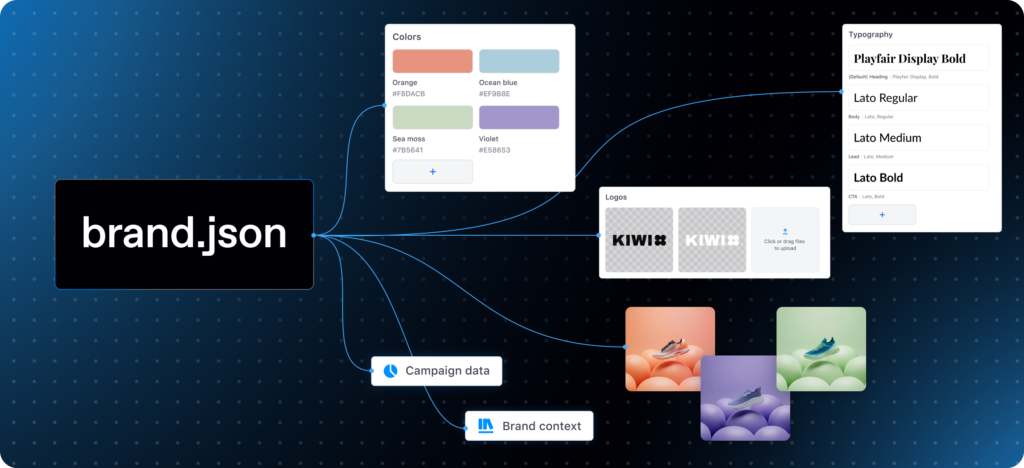
Instead of scraping and inferring, creative agents resolve brand identity directly from the brand itself. And this is just the start; my prediction is that brand.json will grow to accommodate far more than visual identity, such as briefs, audience parameters, campaign guardrails, visual guidelines – anything that helps govern creative output could become part of this system over time.
On-brand output stops being a matter of luck and becomes a matter of protocol. Governance moves from reactive to embedded; it is enforced before creative is generated, not after.
This is what we’re introducing with brand.json as part of AdCP 3.0, and as a founding member of the AAO, we’re proud to have collaborated with the broader industry in shaping how it comes to life.
What agentic advertising unlocks with governance
When brand identity is authoritative and machine-readable, everything downstream gets better.
Brands can move faster, experiment broader, and deploy at scale without the compliance anxiety that’s been slowing adoption. Creative agents stop competing on how accurately they can reverse-engineer your identity and start competing on what actually matters: innovation, performance, distinctiveness.
And crucially: the human stack can finally do the work it was always meant to do. Not fixing what AI gets wrong, but defining what AI is allowed to do in the first place. Governing the system. Shaping the strategy. Curating the brand logic that makes automated creative genuinely great and genuinely yours.
That’s the shift I’m most excited about. Not AI replacing human creativity, but governance infrastructure finally giving human creativity the right job to do.
Governance is the foundation of agentic advertising
There’s a narrative in this industry that frames governance as friction, the thing that slows AI down in the name of safety. I think that framing has it exactly backward.
Governance is what allows creative to scale with trust. Without it, agentic is fast but fragile; with it, speed and quality stop being in tension. The brands that understand this earliest won’t just avoid the pitfalls of uncontrolled AI output; they’ll build the most durable creative advantages of the next decade.
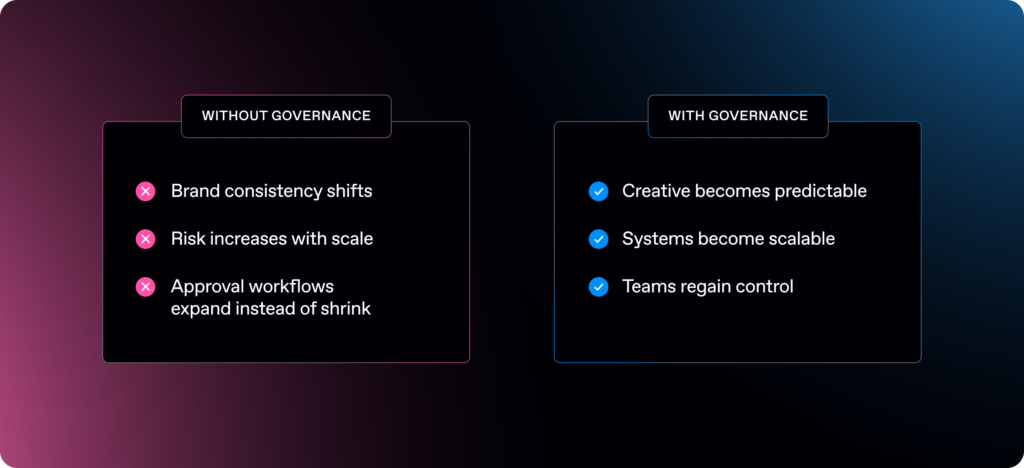
brand.json is how we get there. A simple, open protocol. A direct line from every creative agent to the brand truth it needs. And the foundation that lets the humans in the loop do the work that actually matters.
To all brands, agencies, and partners ready to make the shift – the era of AI guessing your brand is over. It’s time to govern it.
Frequently Asked Questions
Agentic advertising uses AI agents that can autonomously plan, generate, and optimize advertising campaigns. Unlike traditional automation, these systems make real-time decisions, adapt to data, and execute multi-step workflows without constant human input.
Governance matters because agentic systems operate autonomously and at scale. Without guardrails, brands risk inconsistent creative, compliance issues, and loss of control. Governance ensures outputs are reliable, on-brand, and aligned with defined rules.
brand.json is a proposed machine-readable brand file that includes elements like logos, colors, typography, tone, and usage rules. It allows AI systems to generate creative from an authoritative source of brand truth instead of guessing.
Creative automation follows a linear “if-this-then-that” script to produce variations of a fixed asset. Agentic advertising, however, uses autonomous AI agents capable of reasoning, planning, and multi-step execution. While automation scales production, agentic systems scale the entire creative process, making real-time decisions based on campaign goals and data.
The biggest risk is brand dilution at scale. Without a machine-readable truth, agents “hallucinate” visual and verbal identity, using wrong hex codes, unapproved fonts, or off-key messaging. This leads to a “governance debt,” where human teams spend more time manually correcting AI errors than they would have spent creating the ads themselves.
Celtra is a founding member of the AAO. We lead the effort to move the industry from “Chaos at Scale” to “Governance at Scale.” By co-developing the AdCP 3.0 protocol and the brand.json standard, Celtra is helping build the infrastructure that ensures the next decade of advertising is safe, verifiable, and brand-compliant.