Your campaign clears legal, brand, and media approval, then stalls in a different queue: the one where someone resizes it for every platform, translates it for every market, and checks it against brand guidelines by hand. That queue is where enterprise creative teams lose the time they don’t have.
Designers, creative operations teams, and marketing leaders keep getting asked for more ad creative, across more markets and formats, on shorter timelines, without more headcount to produce it. Creative automation platforms like Celtra close that queue: one approved design becomes every resized, localized, on-brand variant automatically, so designers spend their time on creative thinking instead of repetitive production work.
Key takeaways
- Creative automation handles layout, variant generation, and localization, cutting turnaround time without adding headcount.
- Advanced GenAI capabilities, including node-based workflows, AI image expansion (outpainting), and AI background generation, operate within strict brand guardrails to protect brand equity while producing massive asset variety.
- Marketers and local teams can adapt, localize, and activate approved creative toolkits independently, freeing core designers to focus on high-impact creative concepts.
- Built-in AI pre-flight scoring, creative intelligence, and performance-optimized text generation ensure teams back winning assets before launching campaign budgets.
The high cost of manual production and uncontrolled creative
As media strategies become more precise across channels, ad creative frequently lags behind. Complex media plans regularly launch with whatever ad creative happens to be ready, rather than what the channel strategy requires. Traditional production workflows force designers into a grind of manual tweaks, endless revisions, and tedious artboard management, one ad creative at a time. At the enterprise level, that’s hundreds of ad creatives across several channels and markets per campaign, and without guardrails, that multiplies the risk of error, inconsistency, and brand dilution.
As creative operations software, Celtra turns creative production into a structured supply chain, combining enterprise governance with automation and GenAI to bridge the gap between media strategy and creative delivery, so enterprise teams can launch more ad creatives, faster. By centralizing regional workflows with Celtra, McDonald’s produced over 95,000 ad creatives and 131,000 variations across 4 Nordic markets, and achieved a 12.8x increase in production efficiency, averaging just 36 seconds per ad creative.
Core creative automation and modular production
Even with GenAI handling generation and adaptation, most teams still lose time to the basics: resizing, reformatting, and distributing one idea across a dozen ad specs. Underpinning Celtra’s AI capability is a robust, modular production engine that turns one approved design into hundreds of on-brand ad variations.
- Responsive auto-layout and safe zones: Set custom padding, group nesting, and auto-spacing, with safe zones keeping elements clear of platform UI like TikTok or Instagram buttons.
- Multi-position image cropping and bulk actions: Set single focal points across dynamic assets, or batch-crop images side-by-side, saving hours of manual editing.
- Text rules and formatting: Automate line breaks across languages, pair custom text treatments without extra layers, and add animations like typewriter, slide, or fade.
- Motion and animation controls: Edit timelines, easing, and bezier controls with preset animations across video and HTML banners, with real-time previews.
- Brand kits and asset management: Centralize logos, typography, colors, and global styles at the account level, so anyone can apply approved kits with total consistency.
This modular approach delivers real returns: Nike hit a 19.5x gain in production efficiency with Celtra’s global toolkits during their Member Days campaign, generating 17,000+ localized creatives in a single round while keeping full brand consistency. Similarly, Wolt boosted team productivity by over 20x, producing over 300,000 localized assets annually and slashing localization turnaround from a full day down to just 1–2 hours.
Next-gen GenAI and agentic workflows for designers
Creative automation is evolving beyond templated resizing and layout rules. Modern creative automation platforms like Celtra embed GenAI directly into the production process, with AI Creative Flows’ node-based editor and AI image expansion, and an agentic AI assistant to support the adaptations. Figma and Photoshop compatibility rounds out the workflow, letting teams bring existing design work in without breaking stride.
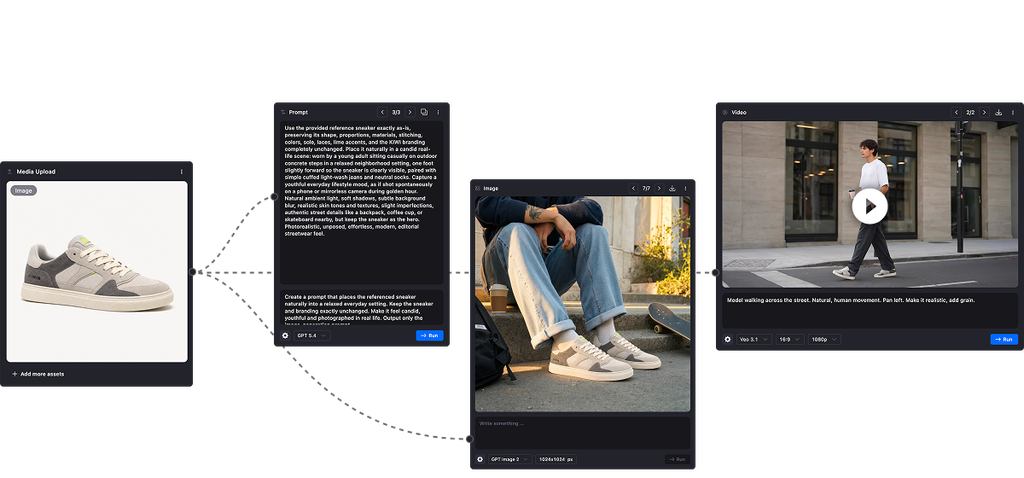
AI creative flows (node-based workflows)
Combine source assets, product feeds, prompts, and tone guidelines in a visual, node-based editor for high-quality image and video generation, while staying fully on-brand.
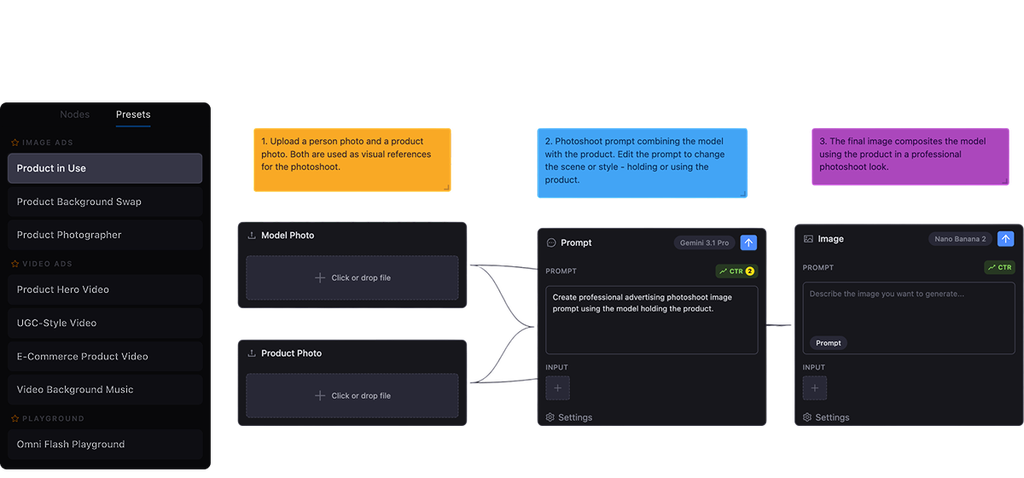
Predefined GenAI presets
Skip the blank page with out-of-the-box prompts for photoshoots, product-in-scene video, and multi-format adaptations.
AI image expansion and generation
Automatically expand original campaign photography to fit non-standard aspect ratios or generate contextual background variations directly inside Celtra.

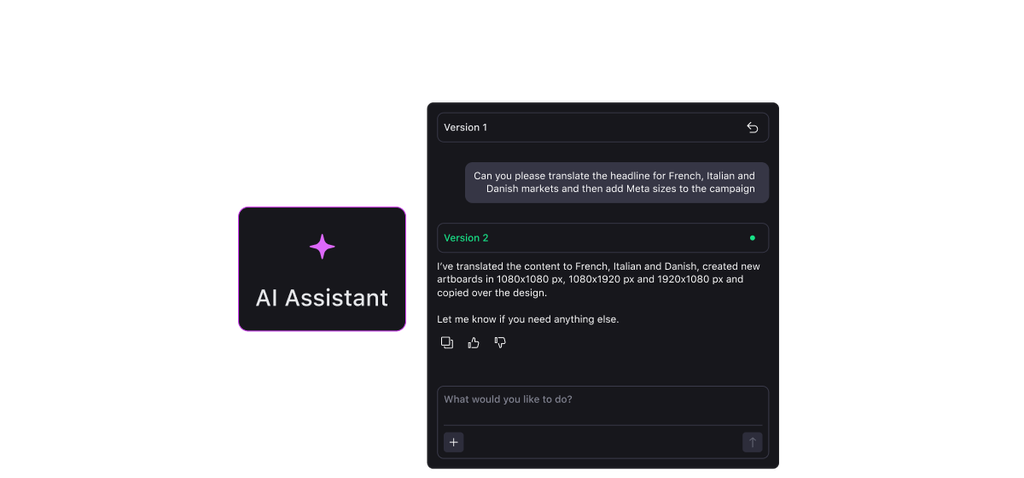
Agentic AI assistant
Execute bulk resizing, localization, and property changes through a chat interface or the Command Menu, without breaking creative flow.
Figma and Photoshop compatibility
Effortlessly copy and paste assets directly from design tools like Photoshop or Figma into Celtra, maintaining complete flexibility.

Creative performance intelligence
Scaling creative production only solves half the challenge. Teams also need to know which ad creative is worth backing with media spend, and feed what’s working into the next round of production, so every new campaign builds on what the last one proved.
Celtra closes that gap with a set of intelligent optimization features that score ad creative before it launches, sharpen ad copy for stronger performance, and reveal what drives results across your ad history. Each evaluates ad creative and feeds what it learns into what gets produced next.
Pre-flight performance scoring with Celtra Score
Evaluate your ad creatives with Celtra Score before it ever launches, checking it against your account’s own historical performance data. You’ll see a predicted result for your chosen goal, like conversions or clicks, so you can catch low performers before they touch your media budget.
Performance-optimized copy with Celtra’s AI-powered text optimizer
Generate headline and copy alternatives with Celtra’s AI-powered text optimizer, informed by your account’s own past performance data. Each variant is built to maximize click-through and conversion rates, not generic AI-generated copy.
Impact analysis with Celtra Creative Intelligence
Run Celtra Creative Intelligence across your entire ad history, in and outside Celtra, to automatically tag every visual and messaging element and rank it by how strongly it influences performance. The result is a ranked view, backed by statistical confidence, of what to scale, test, or cut in your next campaign.
If you’re ready to eliminate production bottlenecks, scale brand-safe ad creative, and maximize media performance, book a demo with our team today and see what Celtra can do for your creative production.
Frequently Asked Questions
Creative automation is technology that automates the repetitive parts of ad production, layout, resizing, localization, and variant generation, so one approved design can scale into hundreds of on-brand ad variations without added headcount. Celtra’s platform pairs this with GenAI workflows and performance intelligence to connect every creative decision to a performance outcome.
Creative automation removes the manual bottleneck of resizing, versioning, and localizing each ad by hand. McDonald’s centralized its regional workflows with Celtra and produced over 95,000 ad creatives and 131,000 variations across four Nordic markets, a 12.8x increase in production efficiency, averaging just 36 seconds per ad creative.
AI pre-flight scoring evaluates new ad creative against your account’s historical performance data before it goes live, giving a predicted result for a chosen goal like conversions or clicks. This lets teams catch low performers and avoid spending media budget on creative that won’t work.
Account-level Brand Kits lock logos, typography, colors, and core assets, so when non-designers or marketers adapt templates for local markets, those guardrails keep every output on-brand. Combined with modular templates and set editing rules, teams can localize and scale content without compromising brand governance.
Yes. Designers build structured modular templates with set rules, allowing marketing, localization, and campaign leads to make text, image, and language edits independently through intuitive content feeds or chat-based AI assistants without altering core layouts.