When enterprise brands evaluate creative platforms, they often lean towards feature comparison. The more revealing question is: what problem is each platform actually designed to solve?
Storyteq addresses a production problem. It helps teams adapt, version, and distribute content across markets at scale through template automation, workflow management, and localization tooling. For brands whose primary need is taking approved creative and rolling it out efficiently across markets and formats, that scope is sufficient.
Celtra starts from the same production challenge, but takes it a step further. It embeds a layer of creative intelligence directly into the platform, connecting predictive scoring, AI-powered production, and media outcomes in one system. This gives teams the agility to move fast, iterate instantly, and connect every creative decision to a measurable outcome.
Choosing the right platform starts with understanding the future you want your creative operations to enable. This comparison examines both platforms across the dimensions that matter most to enterprise marketing teams.
What is Storyteq, and when does it work best?
Storyteq positions itself as a Content Marketing Platform (CMP) focused on content production, workflow management, and cross-market localization. Owned by Team ITG, a UK-based marketing technology and services company, Storyteq is built around the needs of enterprise brands and agency teams managing high-volume campaign production.
Storyteq works particularly well for:
- Brands whose content production is handled primarily by an external agency rather than in-house.
- Teams focused primarily on content localization and versioning at scale across global markets.
- Marketing operations teams prioritize structured, repeatable campaign rollouts over on-the-fly creative flexibility and rapid iteration.
While efficient for standard video and banner variations, Storyteq operates primarily as a production automation system. Deeper creative-to-media performance loop optimization, pre-launch predictive intelligence, and advanced in-platform design editing are notably limited.
What is Celtra, and when does it work best?
Celtra is a creative-first enterprise platform designed to help brands and media organizations scale high-performing digital advertising without sacrificing creative quality or control. Rather than centering on production alone, Celtra embeds creative intelligence across the entire lifecycle, from ideation and production to activation and optimization.
Celtra works well for organizations seeking to:
- Scale on-brand creative across markets and channels.
- Ensure governance and compliance at enterprise scale.
- Embed Generative AI workflows that aid with the creation of scalable AI imagery, graphics, voiceovers, or videos.
- Replace guesswork with predictive creative intelligence.
- Accelerate testing and personalization at volume.
- Reinforce marketing agility with direct and live platform integrations.
With a unified architecture and intelligence embedded directly into the creative system, Celtra is often chosen by organizations that view creative as a primary performance lever, not simply a production output.
At a glance: Celtra vs. Storyteq
Here’s a high-level look at how the two platforms stack up.
| Capability | Celtra | Storyteq |
| Creative quality | Advanced design environment, unlimited creative variety, no compromise on quality. | Limited editing and source file dependency; built for adaptation, not modern advertising. |
| Omnichannel | Full omnichannel activation: social, programmatic, display, video, DOOH. | Primarily social & display; limited cross-channel orchestration. |
| Dynamic creative | Dynamic creative optimization, personalization, and scalable creative testing. | Template-based adaptation and localization; limited dynamic creative functionality. |
| AI capabilities | Brand-governed GenAI, pre-flight scoring, creative performance insights. | Automation-only. No pre-launch scoring, no creative-to-media intelligence. |
| Cost | Fixed, predictable pricing. | Render-based pricing + managed service fees. Costs escalate at scale. |
This overview highlights key differences, but the real distinction ultimately depends on what your organization needs creative technology to do. Let’s look at the most important dimensions to evaluate.
What should you consider when comparing Celtra and Storyteq?
1. Can the workflow keep up with changing creative demands?
This is one of the starkest differences between the two platforms, and one that creates the most day-to-day friction for creative teams.
Storyteq is built around a structured, template-driven workflow. While this approach works well for planned campaign rollouts and large-scale content adaptation, making changes often requires updates to source files outside the platform before assets can be re-exported and redistributed. For teams managing multiple markets and frequent campaign updates, this can slow down iteration and create additional dependencies.
“Setting up the initial template takes a significant amount of effort and demands close collaboration with their onboarding team.”
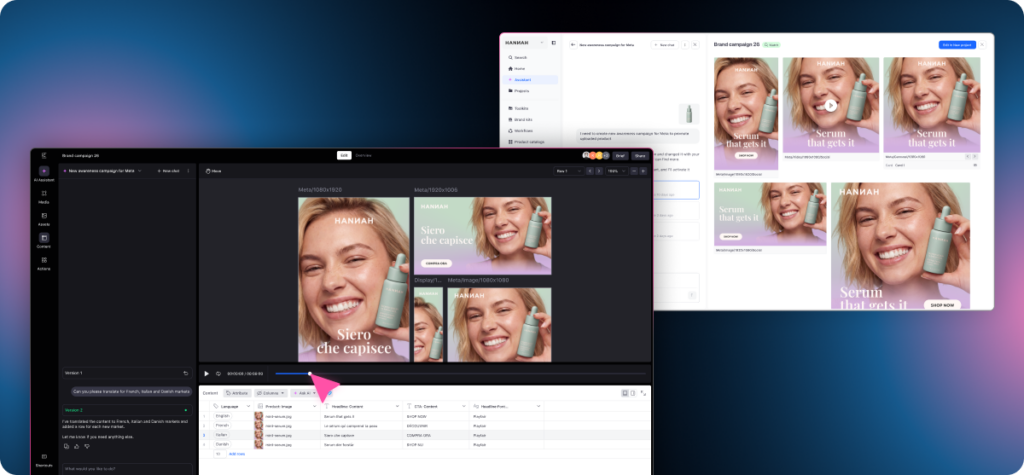
Celtra is designed to give teams greater flexibility throughout the creative lifecycle. Creative updates, approvals, adaptations, and activation can all happen within the platform, allowing teams to respond quickly to new requirements without disrupting existing workflows. Whether launching a new campaign, adapting assets for a local market, testing new creative concepts, or responding to performance insights, teams can move from idea to activation faster.
In practice, this means market teams can operate more independently, approvals happen more efficiently, and creative can evolve alongside campaign performance rather than waiting for production cycles to catch up.
“Celtra helps me templatize variations for different channels in over thirty country markets, which is key given my high-volume workload with limited resources. It allows for the creation of master templates and easily populates various new creative templates and adaptations for A/B testing, which is great for structural, faster scalable creatives.”
2. How does each platform use AI and what it means for performance?
Both platforms claim AI capabilities, but they apply AI in fundamentally different ways.
Storyteq uses AI primarily to automate template production and localization. It helps scale what already exists, but does not evaluate whether that content will perform before it goes live. There is no pre-launch scoring, and no direct connection between creative elements and media goals.
Celtra strategically embeds AI at key moments throughout the creative lifecycle to solve specific challenges around asset creation, performance prediction, governance, and optimization. That includes:
- Enterprise GenAI with brand governance
Generating scalable, media-ready image and video assets within structured design systems, ensuring compliance and brand integrity at scale. - Predictive performance scoring
Evaluating creative concepts before launch to reduce guesswork and prioritize high-performing assets before media spend begins. - Creative performance intelligence
Connecting results directly to visual, messaging, and structural elements, transforming every campaign into a measurable learning system. - Agentic workflows across generation, activation, and insights
Automating production and coordination between teams, linking creative generation, approvals, media activation, and performance tracking in one governed system.
In this way, AI becomes a decision-support layer that strengthens creative effectiveness, protects media investment, and drives sustainable performance over time.
“The incorporation of an AI assistant and workflow features to create new adaptations and variations of concepts makes things much easier.”
3. Can your creative platform keep up with your channel mix?
Storyteq’s activation capabilities are centred on social and display channels. For brands whose campaigns are primarily contained within those environments, that coverage is workable. For brands running campaigns across a broader channel mix, additional tools are needed to fill the gap, which adds complexity, cost, and potential inconsistency across how creative performs in different environments.
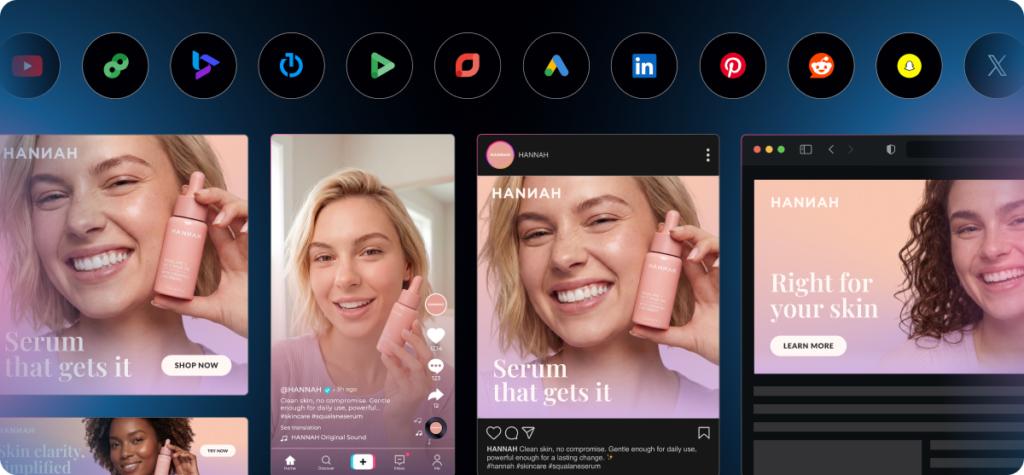
Celtra activates across 100+ media channels natively. Social, programmatic, display, video, DOOH, CTV, and retail media are all supported within the same platform, with prebuilt integrations for Meta, Google, TikTok, DSPs, and retail media networks. Dynamic creative optimization is built in, meaning creative can be personalized and tested at scale across channels. Creative logic, format specifications, and performance tracking are unified, so teams are not managing separate workflows for different channel types.
4. How can you scale creative operations without adding complexity?
As creative volume grows, the scalability of both your platform and operating model becomes increasingly important.
Storyteq’s pricing combines setup fees with a monthly license based on usage metrics such as templates, renders, workspaces, users, or managed service tiers. As campaign volume increases, costs generally increase alongside it. At the same time, a significant portion of the workflow, from template setup to campaign rollout, relies on Storyteq’s internal team. This means that scaling creative production often requires scaling service engagement as well, creating additional dependencies as brands expand across markets, channels, formats, and campaigns.
Celtra’s pricing and service model takes a different approach. Larger commitments unlock better unit economics, helping teams achieve greater cost efficiency as production scales. More importantly, Celtra is designed to support both self-serve and managed service delivery. Global, regional, and local teams can independently create, adapt, and launch campaigns without relying on external support for day-to-day execution, while managed services remain available as an optional resource for onboarding, acceleration, or reducing agency workloads.
The result is a more flexible operating model that allows brands to scale creative output, teams, and campaigns without introducing additional layers of process, dependency, or operational complexity.
Summary: Which platform is right for you?
Storyteq may be a good fit if you:
- Are focused on content distribution and rollout rather than creative performance or media outcomes
- Need to version and localize content across markets and formats at scale
- Are primarily focused on content distribution rather than advertising performance
Celtra is designed for teams that want to:
- Maximize advertising performance through smarter creative decisions
- Optimize creative performance before the media budget is committed
- Obtain a consistent brand execution with flexibility across channels and markets
- Leverage brand-safe AI capabilities built in within the tool
- Value quality, governance, and scalability alongside speed
- Grow creative volume and need predictable, sustainable pricing
Ready to learn more about Celtra?
Ultimately, choosing the right platform starts with understanding your needs and long-term goals. If you’d like to explore how Celtra aligns with your priorities, our team would be happy to connect.
Frequently Asked Questions
Celtra is an end-to-end platform that combines AI-powered production, predictive performance scoring, and direct media activation in one system. Storyteq is a content marketing platform focused on template-based production, localization, and managing high-volume content production through agency-led models.
Yes, particularly for enterprise brands that need more than content production. Celtra adds predictive performance scoring, full in-platform editing without source-file dependency, omnichannel activation across 100+ channels, and a closed creative-to-media feedback loop that Storyteq does not offer. G2 lists Celtra as a top Storyteq alternative.
Storyteq’s production model involves a lengthy downstream process, from template setup through to campaign rollout, that relies heavily on its internal team.Celtra is built to support agile, adaptable workflows with creative can be updated and activated in real time.Whether teams are self-serve or working alongside Celtra’s services team, the platform is designed to keep creative operations fast and competitive.
Storyteq uses a render-based pricing model, which means costs grow as creative volume increases. Celtra uses fixed, predictable platform licensing, making it more cost-effective for teams scaling creative output over time. Get in touch and our team will prepare a personalized quote.
There is overlap in creative production and localization. But Celtra covers a significantly broader scope: predictive performance scoring, in-platform editing, omnichannel activation across 100+ channels, and a closed creative-to-media feedback loop. Storyteq does not offer pre-launch performance intelligence or true in-platform creative flexibility.
The transition requires coordination, but it does not need to be complicated. Celtra provides structured onboarding and migration support to ensure a smooth and successful transition for enterprise teams.