
Every ad creative is a stack of small decisions: who is in the frame, where the product sits, whether the headline mentions a discount, whether the talent wears red socks or white ones. When the campaign ends, the platform report tells you which ads won and leaves finding the reasons to you. Was it one of those decisions, or simply that the winning video ran in Reels, was promoted to your best audience, or was allocated the biggest share of budget? Most teams make an educated guess, write it into the next brief, and hope it holds.
Across my experience working with small and enterprise brands, I’ve seen this question come up time and time again. Creative is the one performance lever that’s unique to your brand, yet it’s the hardest to measure. To this day, marketers have always had a feel for what works in ad creatives, and data scientists want to measure it. Celtra Creative Intelligence brings the two together. It separates the effect of each creative choice from the effects of placement, audience, and budget, across every ad a brand has run. That shows teams where creative investment pays off, so they can build the next brief on evidence instead of a guess.
Key takeaways
- Creative intelligence shows which creative choices in your ads drive performance, and how strongly, so teams can explain results instead of guessing at them.
- Celtra Creative Intelligence breaks down every ad, including ones made outside Celtra, to show which part of the creative actually made a difference, while accounting for factors like where the ad ran and who saw it, to show how reliable each insight is.
- The technology powering the tool draws on detailed reporting from paid social platforms, measures every ad on the same attribution window, and tracks results down to each image and video.
- The real value comes when you know the exact ads to make next, with the right inputs to feed the your next creative decision and brief
What is creative intelligence?
Creative intelligence analyzes which creative elements in your ads drive performance, and why. We use AI models to break each ad asset into discrete creative choices, such as whether people or products appear, colors, and specific messaging, then estimate how each one relates to KPIs like click-through rate (CTR), while accounting for media factors like placement, audience and budget.
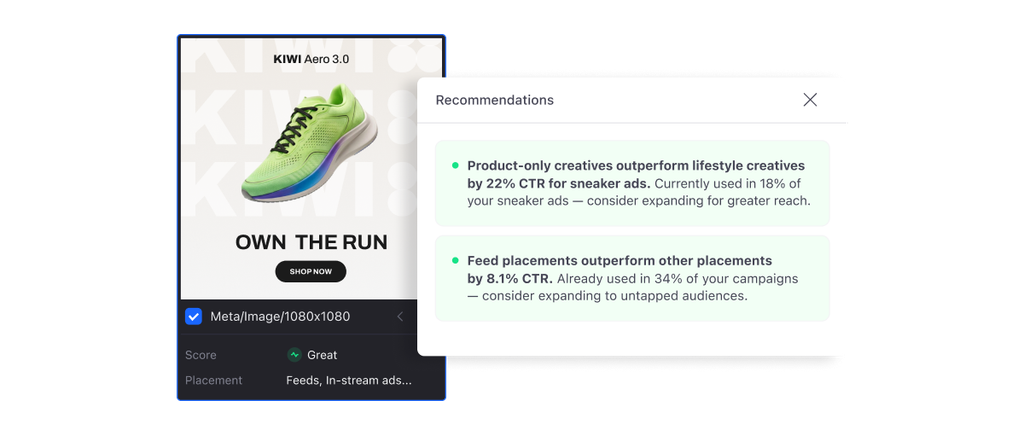
The short version: it turns “this ad worked” into “this ad likely worked because the product was the hero of the frame, and the same pattern holds across hundreds of your other ads.”
Creative intelligence vs. platform reporting and A/B testing
Marketing teams already learn from their creative in two ways. They read the performance reports in each ad platform, and they run A/B tests when a specific question comes up, such as whether a new headline beats the old one. Both are useful, and creative intelligence builds on them. What changes is the question you can answer:
| Platform reporting | A/B testing | Creative intelligence | |
| The question it answers | Which ads performed best? | Which of two versions wins? | Which creative elements drive performance, and how strongly? |
| What it looks at | Results per ad | Difference in results for ads that vary along a 1-axis variable, in a planned test | Results attributed to every creative element, across your whole ad library |
| What you do next | Move budget to the winners | Keep the stronger version | Brief, produce and scale what works |
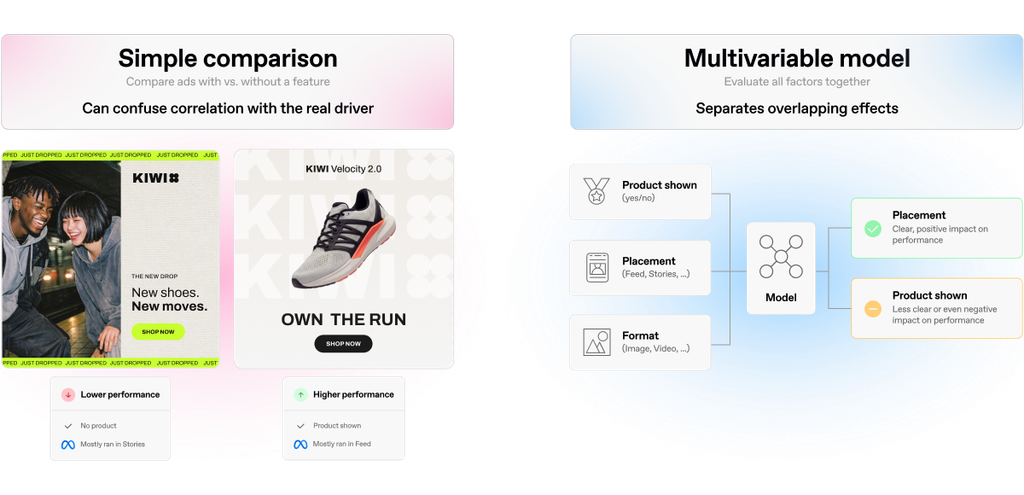
Platform reporting is fast and always on, although it stops at the level of the whole ad and can’t tell you which part of it did the work. Split-cell tests are still the gold standard for causal, validated information about a single question, but they take time. You also have to know what to test before you start. Creative intelligence works on the ads you’ve already run, so it can surface patterns nobody thought to test for.
Why creative is the hardest performance lever to read
Media teams have tuned bidding, targeting and budgets to a fine point, and most of them now use the same platform algorithms as their competitors. That leaves creative as the one performance variable that is unique to each brand. It’s also the hardest one to read, for three reasons.
- Creative and media effects are tangled together: An ad shown to people who were already close to converting, in a placement where impressions cost less, will look like a winner almost regardless of what’s in it. Without separating the two, teams end up crediting the creative for what the media did, or the other way around.
- There are too many decisions to track by hand: A single ad carries dozens of choices, and a brand’s library holds thousands of ads. Tagging them in a spreadsheet works for about a week, until a new campaign lands and the sheet is out of date. People also tag the same ad differently, and a fixed list of tags is difficult to keep up as your creative changes.
- Results stay locked in reports: Even when someone finds a pattern, it often lives in a slide deck the creative team never sees, so the next campaign starts from gut feeling again.
All three point to the same gap: seeing what the creative contributed on its own, across every ad they’ve run, in a form the people who write briefs and make ads can use. And that need runs across the whole marketing team: marketing leaders get evidence for where creative investment pays off, media teams can tell whether a result came from the creative or the media setup, and creative teams get feedback more specific than “make the logo bigger”.
How creative intelligence turns your ad history into your next winner
Three things Celtra Creative Intelligence does that turn your ad history into a decision you can act on:
1. See creative choices you’ve made, without tagging a thing
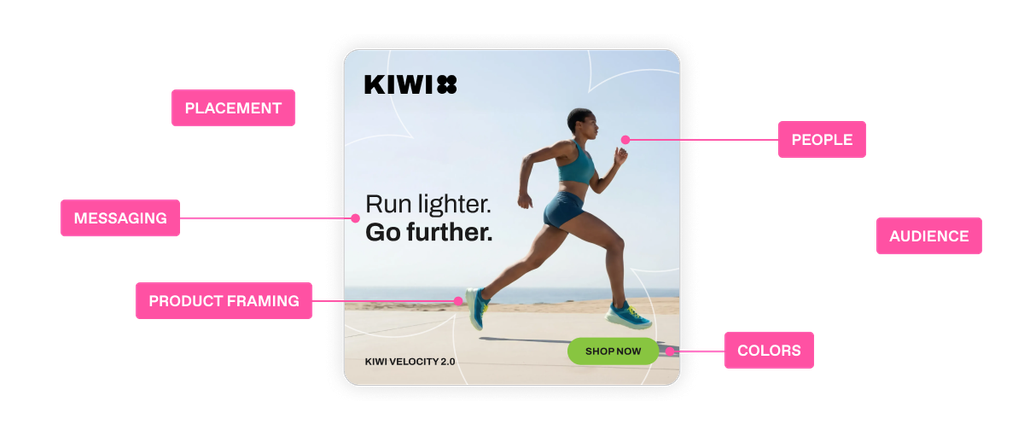
Celtra’s AI model reviews your creative assets and labels the elements that matter, such as people, product framing, colors, text, and messaging. Media factors such as placement, audience, and optimization goal are tagged alongside them.
There’s no fixed list of tags. It catches what’s unique to your brand and elements you might have known to identify, like the face that fronts one campaign. That’s often where the most useful findings are.
2. Know what your creative did, not what your media did
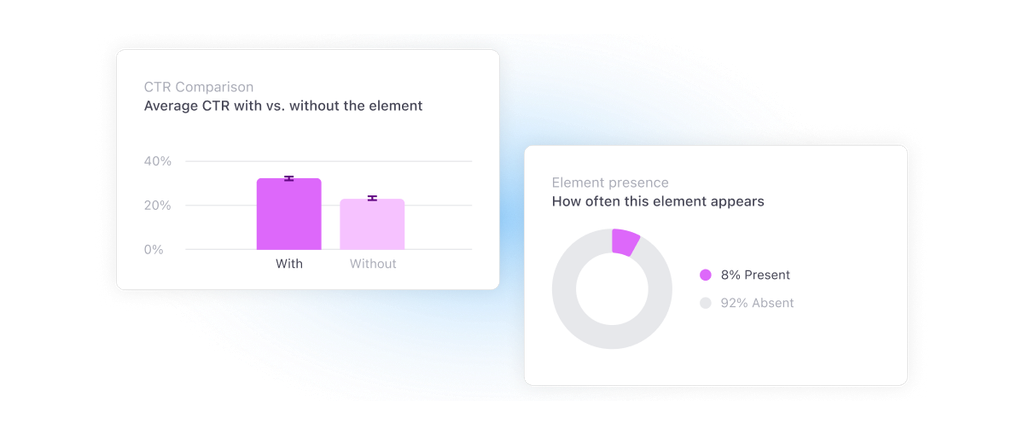
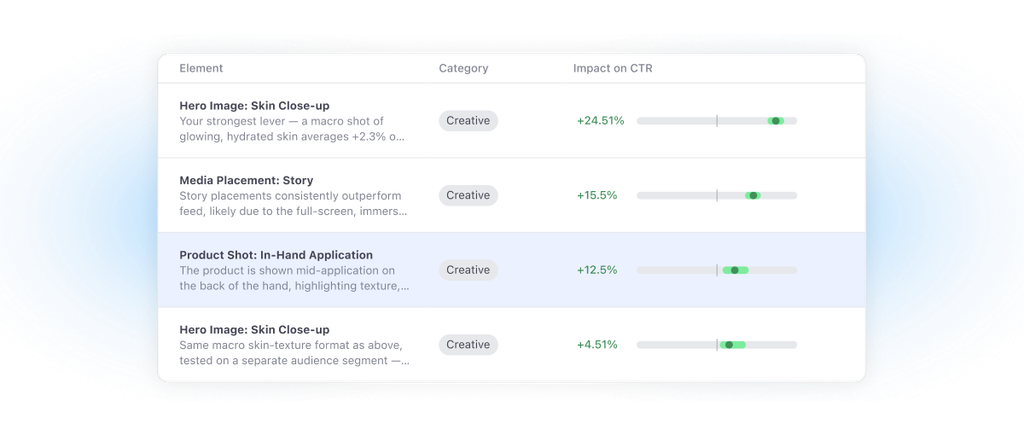
Your top ad may simply have had the best placement or audience. Creative intelligence separates those effects, so each creative choice gets credit only for its own contribution. The result is a ranking of which elements push your target KPI in the right direction, which hold it back, and by roughly how much.
3. Know which findings to bet on
Ad data rarely provides a clean number. Honest ad data rarely gives you one. That’s why at Celtra we use Bayesian methods: for each element, you see its most likely impact and a range around it.
How to put creative intelligence to work
A report nobody acts on is just a very well-informed screensaver. These four steps help teams turn findings into better campaigns:
1. Start with one goal
Pick the KPI that matters most for your next campaign, whether that’s cheaper reach (CPM) or engagement (CTR). The same element can help one goal and hurt another, so the goal shapes the whole reading.
2. Look at the strongest elements and the ones to watch
Start with the elements at the top and bottom of the ranking that have narrow confidence bars. Those are your safest bets to scale or cut. Elements with promising but wide bars are your best candidates for the next test.
3. Check the ads behind each finding
Open the example ads before acting on a result. If the report says product close-ups are linked to a higher CTR, look at those ads and judge for yourself. Numbers tell you what happened, and the ads help you understand why, which is what your creative team will want to hear.
4. Write the findings into the next brief
This is where the value compounds. When briefs say “lead with the product, keep text off the image, and test a person in frame for Stories”, creative and media teams start from the same evidence.
Where creative intelligence is heading
Today, creative intelligence mostly answers “what worked?” and leaves it to a person to decide what to do next. I expect three shifts, in our product and across the industry, to close that gap:
Insights will apply themselves
Right now, someone reads the report, picks the findings worth acting on and writes them into the brief. That handoff is where a lot of good evidence gets lost. More and more, systems like this one will pick out the actionable findings by themselves, meaning the ones with a strong effect and a narrow confidence bar, and with an easy way of intervening for a given situation. The system will apply the creative recommendation where the next ads get made: as defaults in the brief, as guardrails when variants are produced at scale, or as direct alternative variants, ready to distribute with a push of a button.
Hypotheses will test themselves
Today, these creative elements sit on a “worth testing” list until someone finds the time and budget. Soon, intelligence systems will turn them into experiments on their own. They will produce variants that isolate the element, run them in market on a controlled share of budget, and feed the results back into the model. The confidence bar either narrows or the idea gets dropped, and nobody has to schedule an explicit test. At that point, creative intelligence doesn’t just read the past. It closes its own knowledge gaps, becoming an automatic lever in your new, self-improving creative supply.
Insights will get more specific
“Product close-ups work” is useful. “Product close-ups work for the running line in Germany, but lifestyle shots win for the same line in Brazil” is what briefs need. Brand-wide averages hide these differences. Sometimes they cancel out completely, so an element that’s strong for one cohort and weak for another looks like it does nothing. As models learn to share evidence across related products and markets, teams will get reliable findings for a single product line, region, placement, or other variable of interest, even when that slice has too few ads to support a finding by itself.
For most of advertising history, creative was the lever teams pulled on instinct. It still takes instinct to make a great ad, but now you can check your instinct against the evidence before the next campaign goes live. Speaking as someone who used to treat marketing as an art and then fell hard for statistics, that’s the best of both worlds.
Frequently Asked Questions
Creative analytics usually reports how each ad performed. Creative intelligence measures how each element inside those ads affects performance, so you learn why ads perform and what to do next.
Visual, messaging, and format elements discovered in your own library, such as people, product framing, color, text, logos, and offers, plus elements specific to your brand and category. Media factors are analyzed alongside them.
The more ads in your library, the more confident the findings. Larger libraries produce narrower confidence ranges, while smaller libraries give wider ranges, so their findings call for more caution.
No. Split-cell tests answer one question you already know to ask. Creative intelligence works on the ads you’ve already run, so it surfaces patterns worth testing next.
Celtra Creative Intelligence is a dedicated analytics tool in its creative platform. It analyzes your Meta ad history, including ads made outside Celtra, so the insights sit next to the place where the next ads get made.