
Running marketing campaigns across multiple channels, markets, and formats creates an operational load that manual processes can no longer sustain. Marketing automation tools have become the central infrastructure for teams trying to execute faster, reduce repetitive work, and maintain consistent quality as campaign volumes grow.
The category has grown to cover nearly every repeatable task in a marketing operation: email sequences, audience segmentation, social scheduling, lead scoring, and reporting. Creative production has historically been the exception, handled manually even as the rest of the workflow runs on automation. But that gap is closing. Platforms designed specifically for creative automation now bring the same scalability and governance to ad production, handling localization, format adaptation, and volume across channels without rebuilding assets from scratch each time.
Key takeaways
- Marketing automation tools now power the full marketing lifecycle, from email workflows and CRM systems to social scheduling, analytics, and AI-driven creative automation.
- Modern marketing automation platforms are most impactful when they connect execution with creative production, enabling teams to scale campaigns across channels, markets, and formats without manual bottlenecks.
- AI is reshaping marketing automation by accelerating creative production, improving personalization, and enabling real-time optimization based on performance data.
- The strongest ROI from marketing automation comes from faster campaign execution, higher creative output, improved personalization at scale, and more actionable performance insights.
- For enterprise teams, the most important factor is choosing a marketing automation platform that integrates seamlessly with existing systems while supporting scalable creative production workflows.
What are marketing automation tools?
Marketing automation tools are software platforms that handle repetitive marketing tasks so teams can operate at a greater scale without proportionally growing headcount. Companies use them to coordinate campaigns across channels, manage customer relationships, track performance, and reduce the manual work that slows execution down.
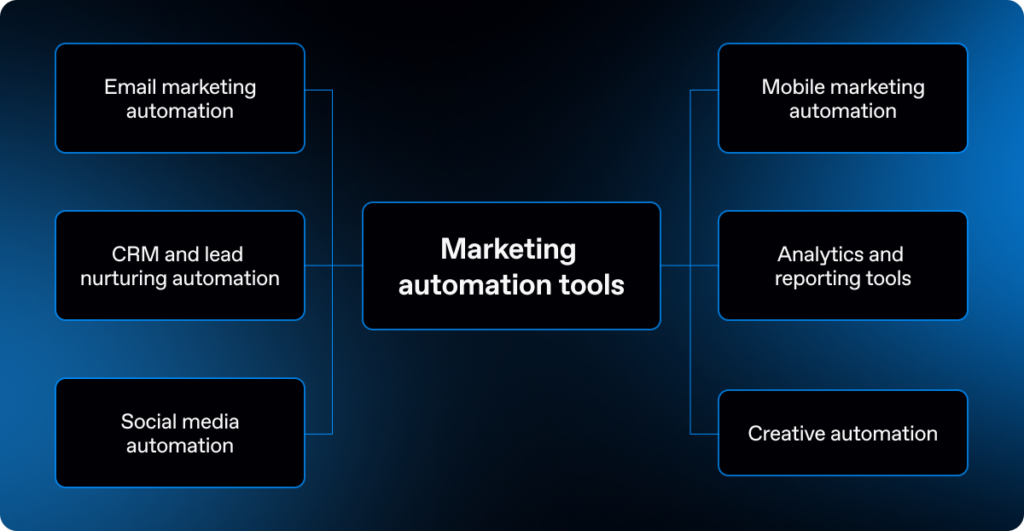
The category covers several distinct functions:
- Email marketing automation handles triggered sequences, nurture campaigns, and newsletters based on user behavior, without requiring manual scheduling for each send.
- CRM and lead nurturing automation manage how prospects move through a sales funnel, tracking touchpoints, scoring leads, and routing them to sales at the right moment.
- Social media automation covers scheduling, cross-platform publishing, and engagement monitoring across channels.
- Mobile marketing automation enables personalized push notifications, in-app messages, and SMS campaigns triggered by user behavior across devices.
- Analytics and reporting tools consolidate campaign performance data into dashboards that teams can act on, replacing the manual process of pulling and reconciling numbers from separate platforms.
- Creative automation addresses the production and distribution side of advertising. For enterprise teams running campaigns across social, programmatic, retail media, and display, this is often where the biggest bottlenecks sit. These platforms help teams generate on-brand variations, adapt assets across formats and markets, and activate directly to media platforms without rebuilding campaigns from scratch each time.
Of these, creative automation is where AI is having the most significant impact. Platforms like Celtra are embedding generative AI, performance intelligence, and agentic workflows directly into the creative production process, reducing friction at every stage from asset creation and localization through to campaign activation.
Key benefits of marketing automation tools
The biggest gains from marketing automation are felt across the entire marketing operation, from customer engagement and campaign management to reporting and creative execution. This section places extra emphasis on creative and advertising workflows because they remain one of the least automated and most resource-intensive areas for enterprise marketing teams. As campaign volumes continue to grow across channels, markets, and formats, automating creative production has become one of the highest-impact opportunities for improving both speed and ROI.
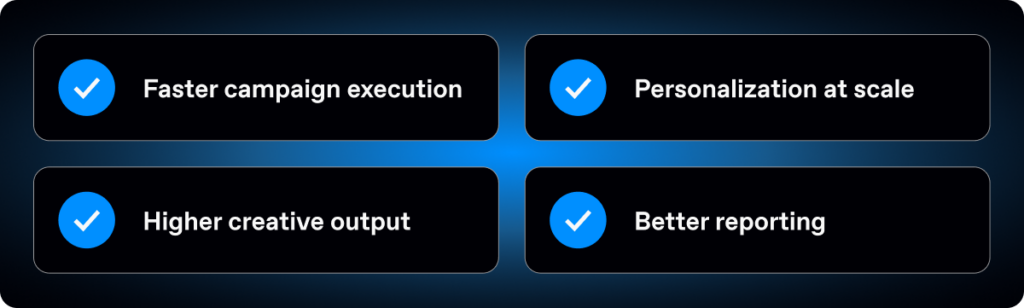
Faster campaign execution
Automated workflows remove the manual steps between strategy and activation. Triggered sequences, scheduled publishing, and structured approval workflows mean campaigns go live faster with less coordination overhead.
Higher creative output
Creative production was the last piece of the workflow to stay manual. Everything around them ran on automation while variations, resizes, and market versions were still built by hand, which is where the largest gap now sits. For advertising-heavy teams, automation compresses the production cycle for ad assets, and AI handles time-consuming work like resizing, localization, and format adaptation, freeing designers to focus on concepts and strategy rather than production tasks that don’t require creative judgment.
Personalization at scale
Serving tailored content to different audience segments across multiple channels isn’t feasible without tooling that handles execution automatically. Automation makes it operationally viable to run highly segmented campaigns at volume, and AI-powered platforms can continuously refine which variations perform best as real-time data comes in.
Better reporting and faster decisions
Automated analytics consolidate data from across channels in a consistent format. AI-powered platforms go further by enabling teams to compare current creatives against past campaign performance, identifying which visual and copy elements have driven results so those insights can inform the next brief rather than getting buried in a post-campaign report.
What to look for in a marketing automation platform
The right marketing automation platform should support your broader marketing ecosystem, not just automate isolated tasks. Whether your priorities are customer engagement, lead management, campaign execution, analytics, or creative production, the best platforms reduce manual work, connect data across systems, and scale with your business. While every organization has different priorities, a few evaluation criteria consistently matter regardless of industry or team size.
Integration with your existing stack
A marketing automation platform should integrate seamlessly with the systems your team already relies on, including CRM, email marketing, advertising platforms, analytics tools, CMS, and creative software. Strong integrations eliminate manual handoffs, keep customer and campaign data synchronized, and allow teams to automate workflows across the entire marketing lifecycle rather than within individual channels.
Scalability
Marketing needs rarely stay static. As campaign volumes grow, audiences expand, and new channels emerge, your platform should be able to handle increasing complexity without requiring teams to rebuild their workflows. Look for a solution that can support both your current operations and your long-term growth.
AI and analytics capabilities
AI is becoming a core capability across marketing automation, from predictive scoring and audience segmentation to content recommendations, campaign optimization, and performance reporting. Advanced analytics help teams understand what drives results, while AI-powered insights reduce guesswork and support faster, data-informed decisions across marketing activities.
Support for creative production at scale
If your organization produces a high volume of advertising and campaign assets, creative automation deserves special attention. Many marketing platforms automate campaign execution but leave creative production largely manual. Platforms that support AI-powered creative workflows, localization, versioning, and format adaptation help enterprise teams remove one of the biggest remaining operational bottlenecks while maintaining brand consistency across channels and markets.
Where Celtra fits in the marketing automation ecosystem
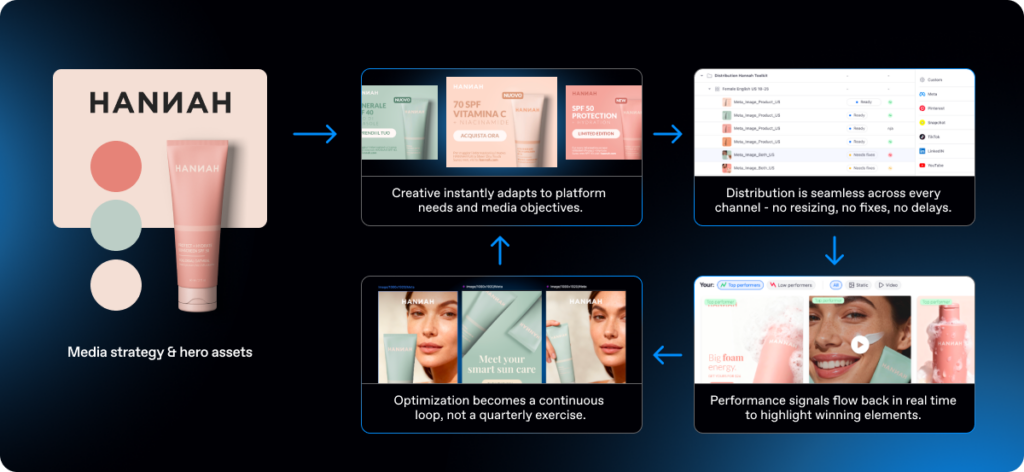
Celtra’s Creative Automation platform connects creative production directly with media requirements and performance data. Design teams focus on core concepts, building intelligent templates and toolkits that lock in brand rules, layout principles, typography, and compliance guardrails. This automated governance lets local teams and media operators safely generate placement-specific formats, tailored copy variations, and market-localized variants on demand, eliminating traditional design bottlenecks and handover friction.
To optimize media budgets, the platform integrates predictive analytics and live performance tracking. Pre-flight scoring evaluates asset effectiveness before campaigns go live, helping teams prioritize winning concepts upfront. Once active, cross-channel performance insights reveal what works and why it works. This information feeds directly back into the production workflow, allowing teams to seamlessly swap underperforming creative mid-flight or adapt new concepts based on continuous evidence rather than guesswork.
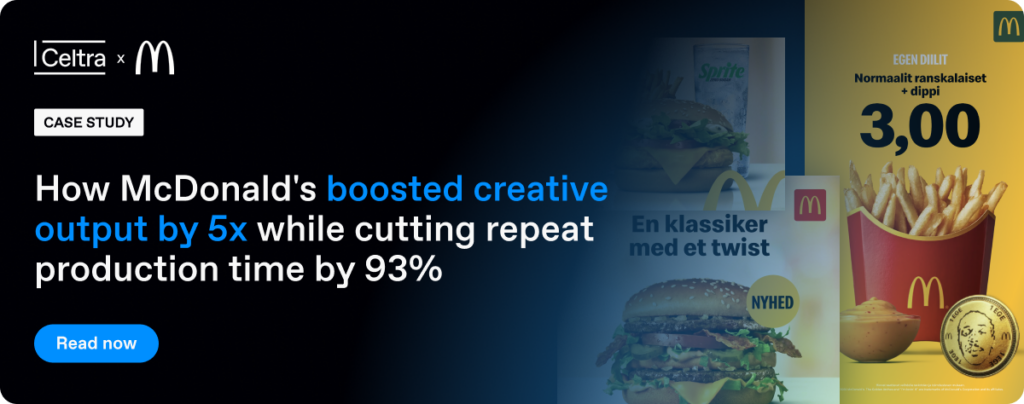
With Celtra, McDonald’s cut repeat production time by 93% while producing 5x more creative outputs, Nike increased production efficiency by 19.5x and Siemens cut CPC by 60%.
Choosing the right marketing automation strategy
Marketing automation tools cover a wide range of capabilities, from email workflows and CRM pipelines to analytics, social scheduling, and AI-powered creative production. For enterprise teams, the most valuable platforms address the specific constraints in their workflows.
Creative production has become one of the most persistent bottlenecks in large-scale advertising. Teams that automate the production layer spend less time on repetitive resizing, versioning, and localization tasks, and more time on the strategy and optimization work that drives results. Platforms like Celtra provide the AI-powered infrastructure to produce, adapt, and activate advertising creatives systematically, at the speed and quality that enterprise advertising demands.
Explore Celtra’s creative automation capabilities or book a demo to see how it works in practice.
Frequently Asked Questions
Marketing automation tools are software platforms that automate repetitive marketing tasks, including email campaigns, lead nurturing, social publishing, analytics, and advertising production. They help teams scale activity without requiring manual input at every step.
A marketing automation platform coordinates and executes marketing activities across channels automatically. Depending on the platform, this includes triggering emails based on user behavior, scoring leads, scheduling content, generating ad variations, and consolidating performance reporting.
Key benefits include faster campaign execution, personalization at scale, higher creative output, better reporting, and stronger cross-team collaboration. For enterprise advertising teams, automation also directly addresses production bottlenecks in creative and localization workflows.
Companies use marketing automation to streamline campaign management, manage customer relationships, coordinate social media activity, and scale advertising production. Enterprise teams increasingly use creative automation platforms to produce and adapt ad assets across channels, formats, and markets without manual rebuilding.
The main types include email marketing automation, CRM and lead nurturing, social media automation, mobile marketing automation, analytics and reporting, and advertising and creative automation. Each addresses a different function within the broader marketing workflow.
Key considerations include integration with your existing stack, scalability, AI and analytics capabilities, and support for creative production at scale. Enterprise teams should pay particular attention to whether the platform can handle the volume and governance requirements of large-scale advertising operations.