It’s launch day, and someone on the creative team is still resizing the same ad for the ninth market. Multiply that across every channel, audience, and test variant a campaign runs, and creative becomes the bottleneck holding the whole plan back, long after media buying solved this same problem with real-time bidding and algorithmic targeting.
Creative automation closes this gap: templates, brand rules, data feeds, and AI working together to adapt, generate, and manage every ad variation automatically. Celtra is a creative automation platform, used by enterprise brands to produce, adapt, and activate ad creative without losing brand control or waiting on a designer to rebuild it by hand.
Key Takeaways
- Creative automation automates repetitive parts of creative production, including adaptations, resizing, localization, variation creation, and campaign delivery.
- The strongest creative automation workflows connect production with performance, allowing creative learnings to inform future production and optimization.
- Creative automation supports personalization at scale by turning approved concepts and brand assets into audience, market, placement, and channel-specific variations.
- Celtra connects creative production, review, activation, and performance intelligence in a single platform, helping teams manage creative as part of the wider advertising system.
What is creative automation?
Creative automation, also referred to as creative production automation or automated creative production, is the use of technology, structured templates, and data feeds to produce and manage large volumes of advertising creative with minimal manual effort.
Traditional creative production often relies on designers manually adapting a core concept for different sizes, placements, languages, markets, audiences, and channels. Every new variation can create another round of design work, review, QA, trafficking, and coordination.
Automated creative production changes that workflow by turning approved creative elements into reusable systems. Teams establish templates, rules, brand controls, and variation logic once. They then use those structures to generate the creative required for different campaign needs.
While most creative automation platforms stop there, Celtra takes it one step further. Celtra combines GenAI production, automated adaptations, creative insights, media activation, and performance intelligence, giving teams a unified environment for producing and activating ad creative.
How creative automation differs from other marketing tools
Creative automation platforms such as Celtra overlap with several technologies used by marketing teams, but their core purpose is distinct.
| Tool Category | Primary Function | Difference from Celtra’s Creative Automation Platform |
| Design Software (e.g., Photoshop, Figma) | Creating and editing individual creative assets. | Design software develops the core creative idea. Celtra uses those inputs as part of a scalable production system, letting users copy and paste directly from Photoshop or Figma to automate adaptations across formats. |
| Digital Asset Management (DAM) | Storing, organizing, and distributing approved static brand assets. | A DAM manages static files. Celtra turns existing brand inputs into dynamic, campaign-ready variations and routes them directly to media platforms. |
| Project Management Software | Coordinating human schedules, deadlines, approvals, and tasks. | Project management tools track human tasks. Celtra automates the production work itself, generating localized and resized variants automatically within predefined rules. |
| Media Platforms & DSPs | Optimizing media buying, targeting, and ad delivery. | Media platforms optimize media execution. Celtra provides the creative supply required to make those media strategies possible and connects performance data back to design decisions. |
Who benefits most from creative automation?
Creative automation provides value to distinct roles across brands and media platforms:
- Marketing leaders: Scale, optimize, and distribute high-performing digital ads while maintaining speed to market and brand consistency.
- Media teams: Easily create diverse, relevant ads and eliminate wasted media spend by ensuring media plans are supported by fit-for-purpose creative.
- Creative teams: Eliminate tedious manual tasks like resizing and reformatting, generating high volumes of ads 5x faster.
Core benefits of creative automation
Creative automation delivers value across three connected areas: production speed, localization at scale, and performance-driven personalization. Here’s what that looks like in practice.
1. Faster creative production and efficiency gains
Manual resizing and adaptation consume significant creative team capacity. Creative automation replaces that manual work with design scaling and reusable templates, so teams generate new variations without restarting production for every asset.
For example, when McDonald’s Finland set out to expand an upper-funnel video campaign across digital touchpoints, adapting assets manually proved difficult. By adopting Celtra’s platform and developing a modular template system, they increased creative output 5x and cut turnaround times to 24 hours. Their repeat launch production time dropped from 27.5 hours to just 2 hours, delivering a 93% reduction in repeat production time.
2. Seamless global localization and regional scale
Global campaigns require creative adaptations for different languages and markets while maintaining a consistent brand expression. Creative automation establishes reusable structures that let local teams or agencies adapt approved creative within defined guardrails.
When delivery platform Wolt expanded across 30+ countries and 1,000+ cities, two designers were manually managing localization for over 20 languages. This created a major bottleneck. By implementing Celtra, Wolt enabled local marketers to customize brand-safe templates independently. Localization time dropped from a full day to 1-2 hours. Wolt produced over 300,000 creatives in a single year, achieving a 20x boost in productivity.
3. Continuous in-flight testing and data-driven personalization
Personalization requires creative variation, but running unstructured tests produces data without strategic direction. Creative automation lets teams create on-brand variations mapped to audience intent, live feeds, or market signals, then measure performance at the individual asset level.
Financial broker IG experienced this challenge in volatile trading markets. They needed to react quickly to market shifts across channels. After switching from Smartly to Celtra, IG connected their ad creatives directly to live financial data feeds and audience search terms. Turnaround times dropped from 72 hours to minutes. IG now serves real-time dynamic ads that move in sync with market changes while ensuring complete compliance in a heavily regulated industry.
Creative automation workflow step-by-step
This is what creative automation looks like in practice: a repeatable workflow that turns one approved concept into every variation a campaign needs, then feeds results back into the next round of production.
Step 1: Establish the creative system
Teams can define colors, fonts, logos, and assets, and build Brand Kits to ensure consistent and efficient design across all projects and templates.

Step 2: Import defined ad concepts
Designers can build concepts in tools like Photoshop and Figma and import them to Celtra via plugins.

Step 3: Expand your asset library
Work from your existing brand assets, or generate new ones directly in Celtra with Celtra’s GenAI.

Step 4: Automate adaptations
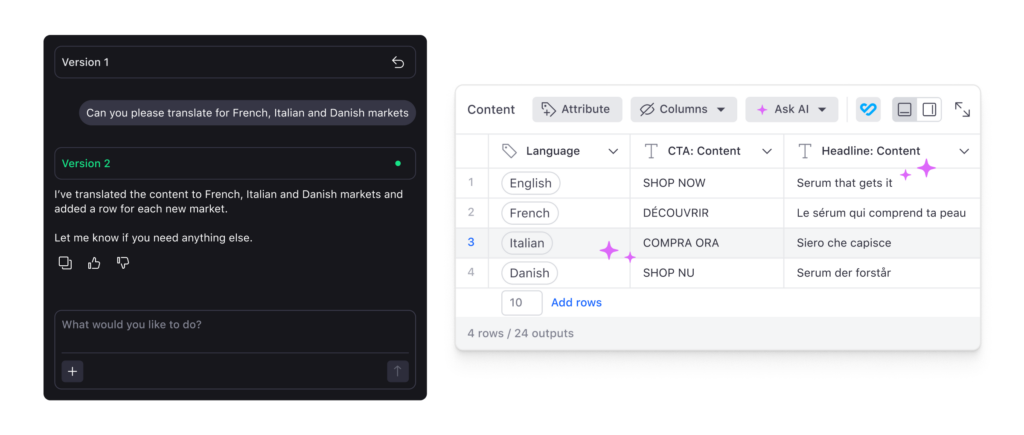
Adapt approved concepts into placement-specific formats, audience-tailored messaging, and localized market variations with the help of Celtra’s AI Agent, no designers required.
Step 5: Review and govern
Teams maintain brand and quality controls while scaling production. In regulated environments, Celtra supports governance through creative guardrails and template-level controls.

Step 6: Activate across channels
Celtra routes assets across social platforms, programmatic display, retail media and CTV.

Step 7: Learn from performance data
Creative performance insights identify high-performing content and feed learnings back into future production.
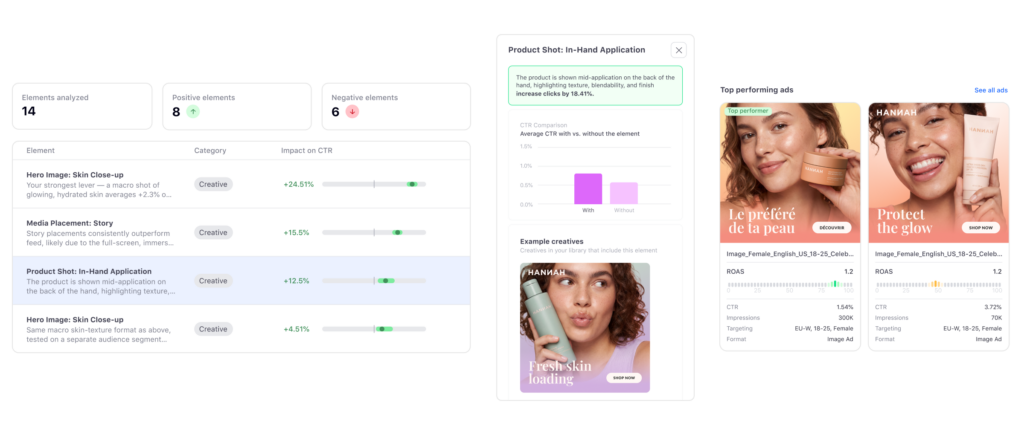
That’s the full creative automation loop: one approved concept becomes every variation a campaign needs, gets reviewed, activated, and measured, and what’s learned along the way shapes the next round before a single new asset gets built. Celtra runs every step of that loop inside one platform.
Frequently Asked Questions
Creative automation is the technology that turns one approved ad into every version a campaign needs, automatically. It uses templates, brand rules, and AI to adapt that ad across formats, markets, and audiences without manual rework.
A typical workflow starts with approved creative concepts, brand assets, templates, and campaign requirements. Automation generates or adapts creative for different formats, markets, audiences, and channels. Review controls maintain quality before assets are activated, while performance insights inform subsequent creative decisions.
The main benefits of creative automation platforms such as Celtra include faster production, easier localization, scalable personalization, reduced manual work, stronger brand consistency, and a tighter connection between creative production and media performance. Celtra combines these capabilities within a single creative platform.
Design software gives creatives detailed control over individual creative assets. Creative automation adds a scalable production system around approved creative, allowing teams to generate and adapt campaign variations automatically. Celtra Creative Automation works alongside established design tools, including Photoshop and Figma.
A Digital Asset Management system primarily organizes and stores digital files. Creative automation uses approved assets as inputs for active, scalable creative production and distribution.
Celtra combines creative production, enterprise-safe AI, brand governance, omnichannel activation, and creative performance intelligence in one platform. Its unified approach connects creative and media workflows so enterprise teams can scale production while using performance signals to inform future creative decisions.